
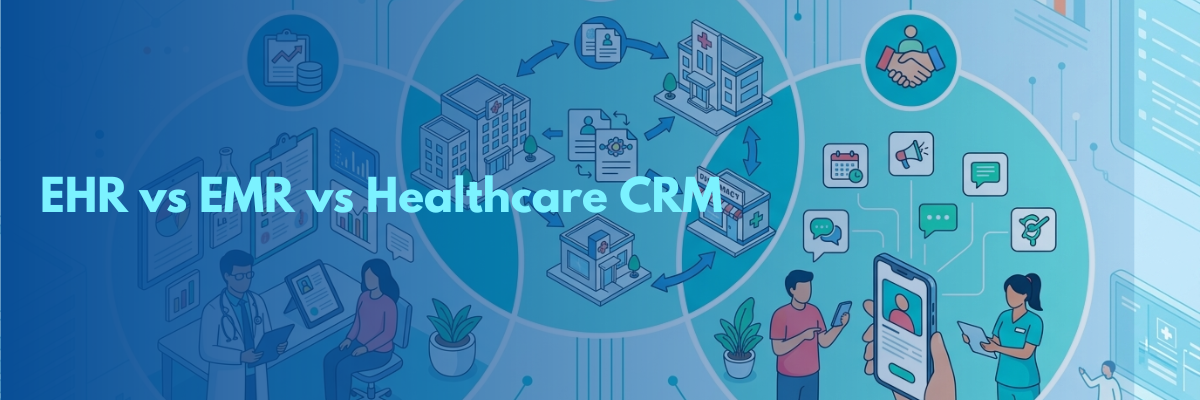
EHR vs EMR vs Healthcare CRM: What's the Difference and Do You Need All Three?
Choosing the right healthcare software can be confusing, especially when comparing EMR, EHR, and Healthcare CRM systems. This guide explains the key differences between these tools, their unique purposes, and how they work together to improve patient care and practice efficiency. While EMRs and EHRs focus on storing and managing clinical records, Healthcare CRMs streamline patient communication, appointment reminders, follow-ups, and engagement. The article also helps clinics, hospitals, and medical tourism providers determine which combination of systems best fits their needs, showing why integrating a Healthcare CRM with an existing EHR can deliver a seamless patient experience and support long-term practice growth.
If you've spent any time at all looking for software tools for your clinic or hospital, you've probably encountered three acronyms: EMR, EHR and CRM. Vendors use them interchangeably, marketers blur the lines, and most buyers end up confused about what they actually need. The confusion has a cost: clinics either pay for overlapping tools or, worse, use the wrong one for the wrong job and wonder why patient experience still feels broken.
This guide cuts through the jargon. By the end, you'll understand all three systems and how each functions, what makes them different from one another and whether or not your practice truly requires all three or simply two of the right combination.
What Is an EMR (Electronic Medical Record)?
An EMR, or Electronic Medical Record, is a digital version of the paper chart a provider traditionally kept inside a single practice. It contains clinical information: diagnoses, medications, treatment history, test results, and physician notes, all recorded for a specific patient at a specific provider's office.
The thing that makes an EMR unique is that, by design, it lives within the four walls of one practice. Once a patient transitions into the care of a specialist, or just moves to another location, their EMR seldom accompanies them. What's more, it's an internal tool for documenting and managing clinical care, not a system built to share information across providers or networks.
Independent or small-group practices that do not require frequent record exchanges with outside institutions commonly use EMRs.
What Is an EHR (Electronic Health Record)?
An EHR, short for Electronic Health Records, is the expanded and more integrated version of the EMR. Interoperability is the key differentiator between EHR and EMR. An EMR is about clinical data collected within one practice, while an electronic health records software system facilitates the sharing of that data among providers, hospitals, labs, pharmacies and even patients themselves.
EHRs provide a broader, longitudinal perspective on a patient's health. Example: A patient who visits their primary care doctor, an orthopedic surgeon and has bloodwork done by a different lab, an EHR can aggregate all of this into a single file that all providers have access to.
For hospitals, larger group practices, or any provider coordinating care across multiple touchpoints, an EHR is the clinical backbone. It handles:
-
Patient health history and clinical documentation
-
Lab results, imaging, and diagnostic data
-
Prescription management and e-prescriptions
-
Care coordination across departments or facilities
-
Patient portal access so individuals can view their own records
The key point: both EMRs and EHRs are fundamentally clinical tools. They record what happened medically. They are not built to manage the relationship side of healthcare, the inquiry, the scheduling, the follow-up, the experience.
What Is a Healthcare CRM?
A Healthcare CRM (Customer Relationship Management system) manages the non-clinical side of the patient journey. Think of everything that happens before a patient walks through the door and after they leave: inquiries, lead management, appointment reminders, post-treatment follow-ups, feedback collection, and re-engagement campaigns.
Where an EHR asks "what is this patient's clinical history?", a Healthcare CRM asks "where is this patient in their relationship with our practice, and what action should we take next?"
The following are the types of data that a modern Healthcare CRM handles:
-
Patient lead capture and routing from website, campaigns, or referrals
-
Automated appointment reminders and no-show recovery
-
Post-treatment follow-up sequences
-
Multi-channel communication (SMS, email, WhatsApp)
-
Lead scoring and patient segmentation
-
International or cross-border patient coordination for medical tourism providers
-
Analytics on patient acquisition, conversion, and retention
Importantly, a Healthcare CRM is not an EHR clinical documentation tool. It does not keep track of diagnoses or treatment records. It manages relationships, not medical charts
EHR vs EMR vs CRM: A Side-by-Side Summary
|
Feature |
EMR |
EHR |
Healthcare CRM |
|
Primary purpose |
Clinical documentation (single practice) |
Clinical records (cross-provider) |
Patient relationship and communication |
|
Data it stores |
Diagnoses, notes, treatment history |
Full health history across providers |
Inquiries, follow-ups, engagement history |
|
Interoperability |
Limited (stays within one practice) |
High (shared across systems) |
Integrates with EHR/EMR and external tools |
|
Who uses it daily |
Physicians, clinical staff |
Physicians, care coordinators |
Front desk, admin, marketing, CX teams |
|
Patient-facing? |
Indirect |
Yes (patient portals) |
Yes (messaging, reminders, outreach) |
|
Regulatory compliance |
HIPAA |
HIPAA + HL7/FHIR standards |
HIPAA (for patient data handling) |
Do You Need All Three? Probably Not.
Well here's the answer in practical terms that most vendors don't tell you, not many clinics and hospitals need all three as standalone systems.
If you are a small independent or single-location practice, an EMR probably handles your clinical documentation and a Healthcare CRM does the rest of the patient-facing work. You likely do not need a complete EHR unless you are providing care management or coordinating care across several external providers.
For a multi-location hospital, group practice or specialty network, the EMR is replaced by an EHR and a Healthcare CRM rides alongside to manage patient engagement. These two together supply you with clinical depth and relationship infrastructure (without redundancy).
For Medical tourism providers or facilitators, clinical documentation may be done by the treating hospital and your primary need will be a Healthcare CRM which is designed specifically to address cross-border inquiries, multilingual communication along with post-clinical follow-up.
The common mistake is treating these as an either/or decision. An EHR and a Healthcare CRM do fundamentally different jobs. Together, they cover the full patient journey: from clinical history to relationship management. Separately, each leaves a significant gap.
The Bottom Line
EMR, EHR, and Healthcare CRM are not competing tools. They solve different problems at different stages of the patient journey. The confusion arises because vendors often overstate what their product covers, and buyers assume one system can do everything.
In reality: your EHR manages clinical history. Your Healthcare CRM manages the relationship. Together, they create the infrastructure for a practice that delivers excellent care and an excellent patient experience, on both sides of the consultation room.
If you're looking for an AI-powered Healthcare CRM built specifically for clinics, hospitals, and medical tourism providers, Curefy unifies patient communication, lead management, and automated follow-ups in one HIPAA-compliant platform, designed to work alongside your existing EHR, not replace it.
Frequently Asked Questions
What is the main difference between EHR and EMR?
The core difference between EHR and EMR is interoperability. An EMR is a digital clinical record confined to a single practice, while an electronic health records software system (EHR) is designed to share patient data across multiple providers, hospitals, labs, and care settings. EHRs give a more complete, portable picture of a patient's health history.
Do clinics need both EHR and CRM?
Yes, in most cases. An EHR handles clinical documentation and medical records, while a Healthcare CRM manages patient communication, follow-ups, lead management, and engagement. They serve entirely different functions and address different gaps. Running only one without the other typically means either poor patient experience (no CRM) or incomplete clinical records (no EHR).
Can a Healthcare CRM replace an EMR or EHR?
No. A Healthcare CRM is not a clinical documentation tool and cannot replace an EMR or EHR for storing medical records, diagnoses, prescriptions, or lab results. What it can do is complement your EHR by handling all the patient-facing, relationship, and communication workflows that EHR systems are not designed for. They work best together, not as substitutes.
Is EHR software HIPAA-compliant?
Reputable EHR systems are built to meet HIPAA compliance standards. Similarly, a Healthcare CRM that handles patient data should also be HIPAA-compliant. Always verify specific compliance certifications, encryption standards, and data handling policies directly with the vendor before adopting any platform.
What type of practice benefits most from a Healthcare CRM?
Any practice that manages a high volume of patient inquiries, runs follow-up sequences, or needs to improve patient retention and engagement benefits significantly from a Healthcare CRM. This includes specialty clinics, multi-location hospital groups, and medical tourism providers managing cross-border patients where manual coordination is not scalable.