
.webp)
Benefits of Electronic Health Records (EHR) in Hospitals & Clinics | Top 10 Listed
Electronic Health Records (EHRs) offer significant benefits to hospitals and clinics, primarily enhancing patient care through instant, secure access to comprehensive health records. Key advantages include reduced medical errors, improved diagnosis, streamlined administrative workflows, better care coordination across providers, and increased patient engagement via portals.
This blog focuses on the top 10 benefits of electronic health records for hospitals and clinics.
Ever since the HITECH act, long gone are the days of healthcare professionals manually filling in patient information on paper and later on computer. An electronic health record has been healthcare worker’s (HCW) companion for over a decade now and stores information electronically - cutting down on hurdles healthcare staff would face.
Electronic Health Records help hospitals and clinics manage health information collected over time by healthcare providers. Also known as EHR, it is a longitudinal, comprehensive record of patient’s health history such as lab results, medications, doctor’s notes and more accessed only by authorized healthcare professionals.
The following sections will share with you the 10 benefits of using EHR in your healthcare practice.
What is an EHR?

As understood above, an Electronic health records software helps healthcare practices digitize patient’s paper chart - it contains essential health information which is collected over time. EHRs are much broader than electronic medical records (EMRs) which are typically restricted for use by single providers or practice.
EHRs cover patient records across different care settings and providers, providing seamless use of a single platform.
Until 2016, patients did not have immediate access to electronic health information which changed with the 21st Century Cures Act which banned information blocking to health data via apps or portals. When your practice uses a HIPAA compliant EHR, you automatically protect patient's data which increases their trust and reliance on your clinic/hospital.
Typical Features of an EHR
Here are the typical features of an EHR:
-
Patient’s demographic
-
Medical history, diagnoses, past illness data, surgery and medication records
-
Progress notes, test results and patient’s vital signs
-
Treatment plans, immunization history, allergies and prescriptions
-
Radiology images
-
Insurance and billing information
Main functions of EHR:
There are three key functions that EHR plays within a healthcare practice:
-
Identifying and maintaining patient record digitally which is more efficient, convenient and secure.
-
Provide a centralized location for patient demographic information - allowing quick access to important patient information.
-
Manage documents outlining health concerns for every patient as well as broader systems within specialty or health system.
Serving these functions allows EHRs to make your healthcare practice more efficient, interoperable and protected from safety risks.
Key Benefits of Electronic Health Records for Hospitals & Clinics
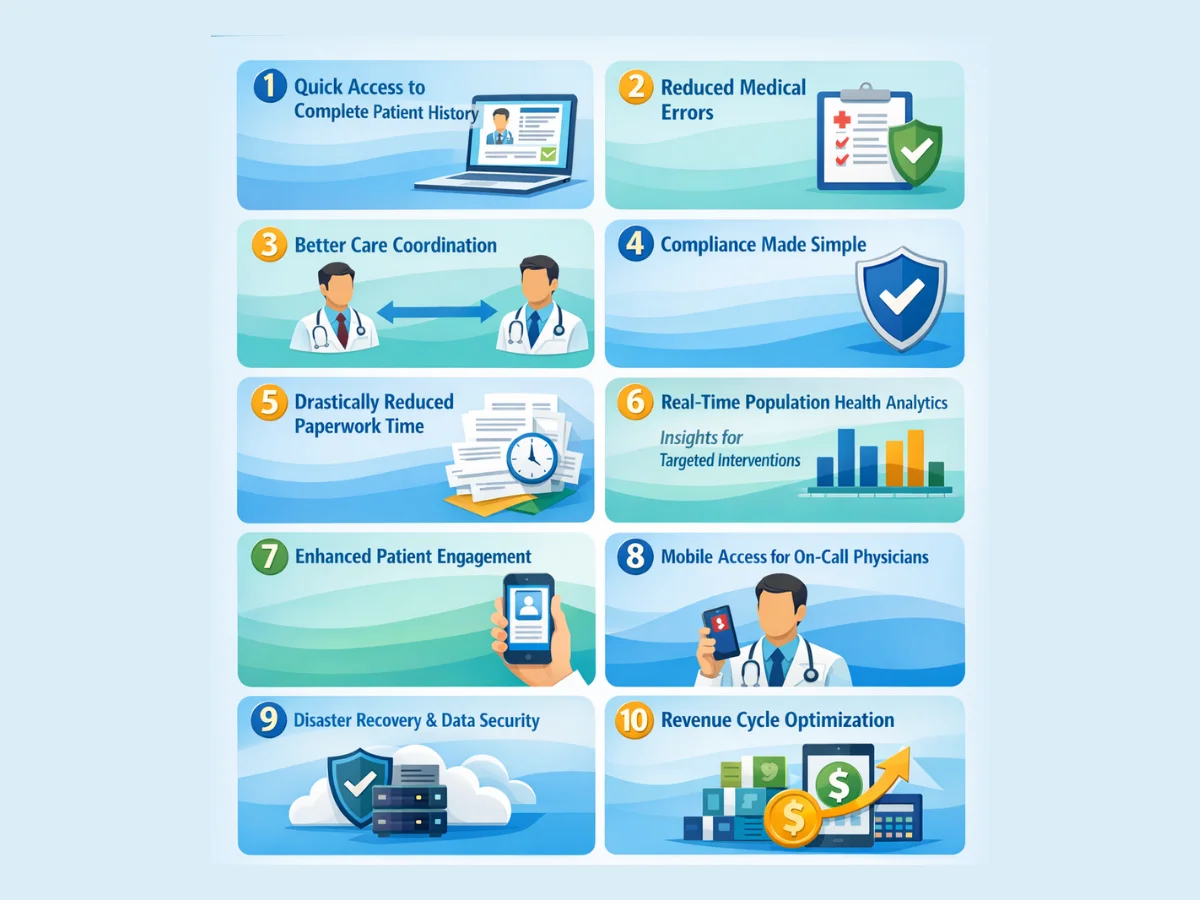
Now that you know about the features and key functions of EHRs, here are the benefits of electronic health records for hospitals & clinics:
1. Quick Access to Complete Patient History
This one’s a no-brainer as the whole point of digitizing patient health records was improving convenience for the healthcare workers who are always in the middle of chaos when running a healthcare practice.
Flipping through paper charts is no more an option that HCWs dread. EHRs provide real-time access ti medications, past procedures, allergies and lab results from any device.
Let’s say you are a cardiologist in Chicago reviewing patient’s cardiac history during an emergency consult without waiting for the fax to come in.
2. Reduced Medical Errors
Electronic health medical records come with built-in clinical decision support that flags dangerous drug interactions and incorrect dosages before they reach patients.
Studies also show that EHRs cut serious medication errors by more than 50% which is critical in high volume hospitals.
3. Better Care Coordination
When a patient visits multiple specialists, EHRs ensure seamless data sharing, - allowing primary care doctors, oncologists and surgeons access to the same updated records instantly.
This eliminates duplicate records and ensures every provider has the complete patient context.
4. Compliance Made Simple
Electronic health record apps automatically document HIPAA compliance, Meaningful Use requirements and MIPS reporting. Curefy’s EHR come with built-in audit trails that track evert access and change - no more requiring manual paperwork as system generates compliance reports with a single click.
5. Drastically Reduced Paperwork Time
Healthcare workers would spend more than 2 hours per day on documentation with paper charts, EHR software like Curefy inclue voice-to-text, templates and auto-population that cuts charting time by 50% - helping US physicians reclaim hours weekly for dedicated patient care.
6. Real-time Population Health Analytics
Electronic health records in healthcare provide dashboards tracking disease trends, vaccination rates and readmission risks across patient population.
Public health departments and ACOs use such insights for targeted interventions.
7. Enhanced Patient Engagement
Modern EHR patientr portals let patients see their test results, request medication refills and message their healthcare team securely. This helps practice increase patient engagement by 40% with digital access.
8. Mobile Access for On-call Physicians
Electronic health record app functionality helps ER docs, hospitalists and surgeons access charts from their device during emergencies and daily rounds. Freeing them from desktop stations and physical charts.
9. Disaster Recovery and Data Security
Electronic medical record apps protect against floods, fires, and ransomware with automatic encrypted backups with 99% uptime which guarantees access during crises.
10. Revenue Cycle Optimization
EHRs with integrated billing catches coding errors, reduces denials by 25% and streamlines claims. Clean claims translate to faster processing and better cash flow for US practices.
How does EHR Implementation Translates to Success

So far, US practices have seen tremendous growth with EHR implementation where User adoption have resulted in 95% better physician satisfaction, with a retunr on investment within 12-18 months. Several EHR software providers like Curefy offer quick support response of less than 2 hours which helps practitioners facing hurdles solve them fast.
Modern EHR systems comes with flexible options that leaves a lot of room for customization - from templates that fit your practice's needs to your clinic's logo and branding visible across the platform. Your team gets a quickstart with EHR as it takes less than a day for some brands to finish setup for your practice.
Why US Doctors Should Choose EHR Now
The benefits of electronic health records increases over time - the initial setup cost is minimal, with your practice recovering the costs within 18 months or less. It boosts efficiency for your practice which helps boost revenue too. With constant updates in medical practice laws and patient safety (HIPAA, patient portal mandates, etc.) EHR adoption is no longer optional if you want to compete with US practices.
Elevate your practice's success with the best EHR in the sector - get in touch today to get started on transforming your clinic/hospital to meet the medical standards your patients demand.
Frequently Asked Questions
1Which are the top EHR system in 2026?
EHR systems in 2026 are an essential for healthcare practices - big or small. Here are some of the top EHR software for healthcare practices:
- Curefy
- Tebra
- Athenahealth
- SimplePractice
- CharmHealth
2Does EHR help healthcare practices become HIPAA compliant?
Yes, the current requirements of running a healthcare practice in the US mandates an EHR for HIPAA compliance - this does not just keep your practice safe from lawsuits, but builds and strengthens your patient's trust - a bigger win than saving your practice from legal charges.
3Can I use CRM with EHR for my clinic?
Yes, several healthcare software companies like Curefy, NexHealth, Tebra and HubSpot among others, provide CRM with EHR integration that solve several healthcare problems from a single platform.