
AI Agents in Healthcare Industry: Benefits & Use Cases
AI agents in healthcare are transforming how clinics and hospitals manage daily operations, patient communication, and administrative workflows. By integrating artificial intelligence, natural language processing, CRM systems, and electronic health records, these agents can automate appointment scheduling, patient follow-ups, lead management, reminders, and routine inquiries. This blog explores the key benefits, essential components, and practical use cases of healthcare AI automation, including patient support, billing, feedback collection, and workflow coordination. It also explains how AI agents complement healthcare professionals by reducing repetitive tasks while maintaining human oversight. Discover how solutions like Curefy App help clinics build more connected and efficient patient management workflows.
Unlike traditional automation that only follows fixed regulations, AI agents in healthcare presently have the ability to combine workflow automation, AI, NLP, and access to connected systems to handle numerous tasks simultaneously. For medical facilities, this includes processing leads, responding to incoming queries, sending follow-ups, and scheduling appointments.
The World Health Organization notes that the potential of artificial intelligence spans across clinical care, patient-guided processes, and administrative and clerical healthcare tasks, while maintaining privacy, governance, and human oversight.
Learn What Exactly Is Meant by an AI Agent in Healthcare?
An AI agent is a software-based system that utilizes artificial intelligence to perform tasks related to healthcare to a degree of autonomy. Healthcare agents receive support from AI agents for purposes like receiving information, identifying it, decoding it, and interpreting the preferred action according to the available information extracted from connected systems like CRMs, calendars, omnichannels, and EHRs.
The following query demonstrates one of the main purposes of AI agents for healthcare and how they have succeeded in the industry.
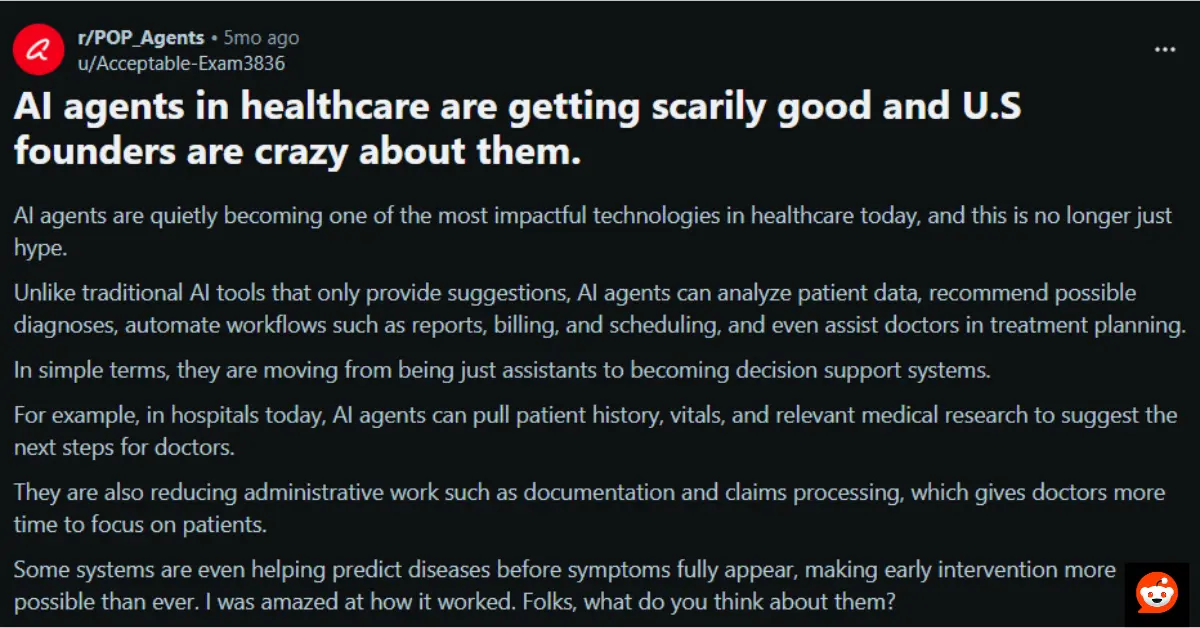
As per the query mentioned above, AI agents in healthcare are rapidly becoming more than just suggestive tools. They can now completely understand defined workflows, information, and documentation, schedule appointments and consultations, and the list goes on to help the clinical team in apt decision-making.
Why Are AI Agents for Healthcare Crucial in Present Time?
The entire healthcare industry from all over the world has been overwhelmed by the pressure of unmanageable administrative workload handled by an inefficient workforce. As per the American Medical Association, professionals like physicians and administrative workers are required to spend nearly two hours outside their working hours to organize documentation directed to patient care.
According to the WHO, a massive shortfall of 10 million health workers is likely by 2030. With this upcoming deficiency, healthcare AI automation can support workers with repetitive tasks and let them focus on more critical work that requires professional judgement.
Some of the tasks that can be handled by AI agents are the following:
-
Scheduling or cancellation of appointments
-
Reaching out to patients regarding routines and inquiries
-
Sending regular reminders
-
Capturing essential patient information for required treatments
-
Identifying patients with unreplied queries
-
Following up with patients post-consultations
-
Handling administrative work
The purpose of adapting help from AI agents for healthcare is to simply add value for a coordinated workflow rather than replacing manual work, to support professionals, and to open medical technologies for more precise results.
Explore the Advantages of AI Automation for Clinics
AI agents make healthcare more accurate, instant, and easier for both patients and doctors to keep up with the growing pace of the industry.
|
Advantage |
AI Capability |
Impact |
|
Admin Work |
Fills out forms, takes notes during visits, and schedules appointments |
Specialists spend less time on admin work and more with patients for proper diagnosis |
|
Clinical Support |
Suggests the best treatment for patients by analyzing their medical history |
Works as a smart assistant to help professionals avoid errors |
|
Patient Support |
Provides a 24/7 smart assistant to book appointments and respond to common questions. |
Patients don’t need to wait or sit in long lines |
|
Identifying diseases early |
Identify subtle signs of sickness via X-rays, lab results, and MRI images |
Catches acute illness, making the upcoming treatments more precise |
|
Advanced Patient Monitoring |
Now found in even smartwatches and phones, which help diagnose data like oxygen levels, calories burned, and heart rate from the patient’s residence. |
Alerts doctors or surgeons immediately, which avoids emergencies |
|
Operations |
Deals with the hospital’s capacity in terms of nurses, beds, clinical trials, and scheduling required |
Resulting in an organized medical facility providing efficient treatments to patients, |
Crucial components of AI Agents for Healthcare
To deliver reliable, secure, and empathetic automated interactions, AI agents for healthcare depend on the following layers:
-
Large language Models (LLMs): Support systems in understanding and creating natural-style responses.
-
Natural-Language Processing (NLP): Equips AI agents to analyze patients’ messages and identify the intent, like asking about the clinic, treatment, how to book an appointment, or for a follow-up.
-
CRM & Healthcare Data Integration: Combined with approved healthcare systems, this allows the AI agent to operate on applicable information instead of just working as an isolated chatbot.
-
Immediate Escalation: Involves immediately reacting to scenarios like patients’ sophisticated queries passed on to the staff and diagnosing serious symptoms.
-
Scheduling Integration: Allows AI agents to look for availability and support patients’ appointments, rescheduling, and cancellations.
-
Channels to Communicate: Operates across platforms such as SMS, websites, voice systems, messaging platforms, email, or main patient portals.
-
Compliance Framework: Ensures all types of communications are compliant with HIPAA and BAA regulations via end-to-end encryption.
-
Thorough Analysis: Identifies the analytics of the clinical dashboard, such as incoming inquiries, response time, no-shows, and follow-ups, to guide clinics to improve their system and given facilities.
How are AI Agents Revolutionizing the Healthcare Industry?
Sources like Gartner have predicted that a minimum of 15% of day-to-day decisions will be made through agentic AI by the year 2028, with the healthcare industry being the dominant adopter due to the large volume of repeated tasks.
The revolution of AI agents for healthcare doesn’t only aim at administration but also at clinical environments. Healthcare AI automation today has shifted from reactive to proactive patient relationship management.
Conventionally, clinics and hospitals are relied on patients reaching out to them for their services. But with the changing trend, AI automation for clinics has entirely reshaped the dynamic of patient-to-clinic conversation.
Major Use Cases of AI Agents in Healthcare
Whether it's patient communication or managing appointments and follow-ups, AI agents are continuously evolving daily operations to assist healthcare teams work efficiently.
-
Patient Lead Capture & Qualification: AI agents capture inquiries from numerous platforms, respond to them with common questions, and send the qualified lead to the suitable coordinator for further assistance.
-
Scheduling Appointments: Agents help patients seek suitable appointment slots to book, modify, or cancel either through chat or voice.
-
Automated Follow-up: AI for patient follow-up takes place post-procedure to check on the patient’s recovery, advise on aftercare instructions, and ask common questions regarding visible symptoms.
-
No-show & Reminders: Mainly used for scheduled messages to minimize no-shows by including required preparation steps, documents required for further processing, and directions.
-
Waitlist & Cancellation: Agents offer waitlisted patients the opportunity to book their appointment after a slot has been opened up due to cancellation of the confirmed patient. This helps the clinic recover the lost revenue.
-
Treatment Support: Support patients in staying on their treatment plans via regular check-ins and reminders. Also involves compiling important information to refill patients’ prescription requests.
-
Billing, insurance & payment: Handles required insurance verification along with outstanding invoices, co-pays, and payment plans, reducing excessive tasks for the front desk.
-
Review and Patient Feedback: Patients get a personalized survey post-visit, consultation, or treatment, which helps determine the clinic’s reputation on platforms like Google reviews.
-
Management of Chronic Illness: Patients suffering from chronic diseases such as hypertension, diabetes, etc., receive personalized nudges from AI agents to monitor their blood pressure, daily glucose, and sustain a healthy routine.
-
Admin Support: AI systems' administrative team automates internal tasks and communication. When a request lies outside of an AI agent’s expertise, it is then directly transferred to a human coordinator rather than being resolved independently.
Also Read: How AI Is Transforming Patient Management in 2026
What’s next for AI Agents in Healthcare?
The future of AI for healthcare is quickly moving forward to more connected and smarter workflows, as AI agents seamlessly schedule appointments, work on CRM platforms, handle inquiries, and deal with patients’ follow-ups and reminders. The World Health Organization has identified the serious potential of artificial intelligence in the healthcare sector with the purpose of ensuring transparency and safety.
For instance, AI solutions like Curefy bring out such capabilities together through powered workflows, smart chat automations, voice AI follow-ups, appointment reminders, and many more healthcare features. As artificial intelligence continues to evolve in healthcare, clinics that avail such features while sustaining human potential can build more connected and efficient medical experiences for patients.
Frequently Asked Questions
1What is the role of AI agents in healthcare?
They are software systems driven by artificial intelligence that can carry out multiple workflows, lead responses, schedule appointments, and work across hospitals and clinics, serving as tools under human guidance.
2How are AI agents and chatbots different from each other?
Chatbots strictly answer scripted questions, whereas AI agents carry out major actions such as updating records, scheduling appointments, and following up with patients.
3Is AI automation in existence to replace healthcare professionals?
AI in healthcare is utilized to support professionals by automating certain admin and communication tasks that take many unnecessary hours. It surely cannot replace healthcare experts since clinical decisions require professional judgement.
4What is the benefit of healthcare AI automation?
One of the major advantages of AI is its ability to perform repetitive, organized tasks rigorously and consistently without making any mistakes. AI agents come in handy for clinics with appointment workflows, lead response, patient communication, reminders, and admin work.