
.webp)
How Hospital Patient Management Software Streamlines Daily Operations
Hospitals are moving away from simple EHRs to adopt modern technology that allows them to do more with better efficiency and patient care. A hospital patient management software does much more than an EHR - from securely storing patient data to appointment handling and billing - making daily operations that much easier for team across different levels.
This blog focuses on highlighting the benefits of using hsopital management system to improve your daily operations without the healthcare workers ever burning out.
Hospital patient management software helps hospitals run faster, reduce manual work, and improve patient experience. For administrators, doctors, and front-desk teams, it creates one connected system for registrations, records, appointments, billing, and reporting.
A hospital management software makes clinical and administrative operations smoother, by bringing components like appointment scheduling, patient records and more as discussed below.
The following sections will explore the different ways hospital patient management software makes daily operations easier for professionals.
Why Patient Management System Matters for Hospitals
Hospitals handle dozens of moving parts every day: patient admissions, appointment scheduling, lab coordination, discharge planning, and billing. Without a central system, teams lose time on paperwork, duplicate data entry, and phone calls.
That is where hospital patient management software becomes valuable. It centralizes patient information, improves communication across departments, and makes routine workflows more efficient.
What is Hospital Patient Management Software?
Hospital management software is a digital platform that helps healthcare providers manage patient data and hospital operations in one place. It usually includes modules for registration, scheduling, electronic medical records, billing, inventory, reporting, and discharge management.
In many hospitals, this also connects to hospital records online, allowing authorized staff to access patient information securely from different departments or locations. This reduces delays and improves continuity of care.
How Hospital Management Software Streamlines Daily Patient-related Operations
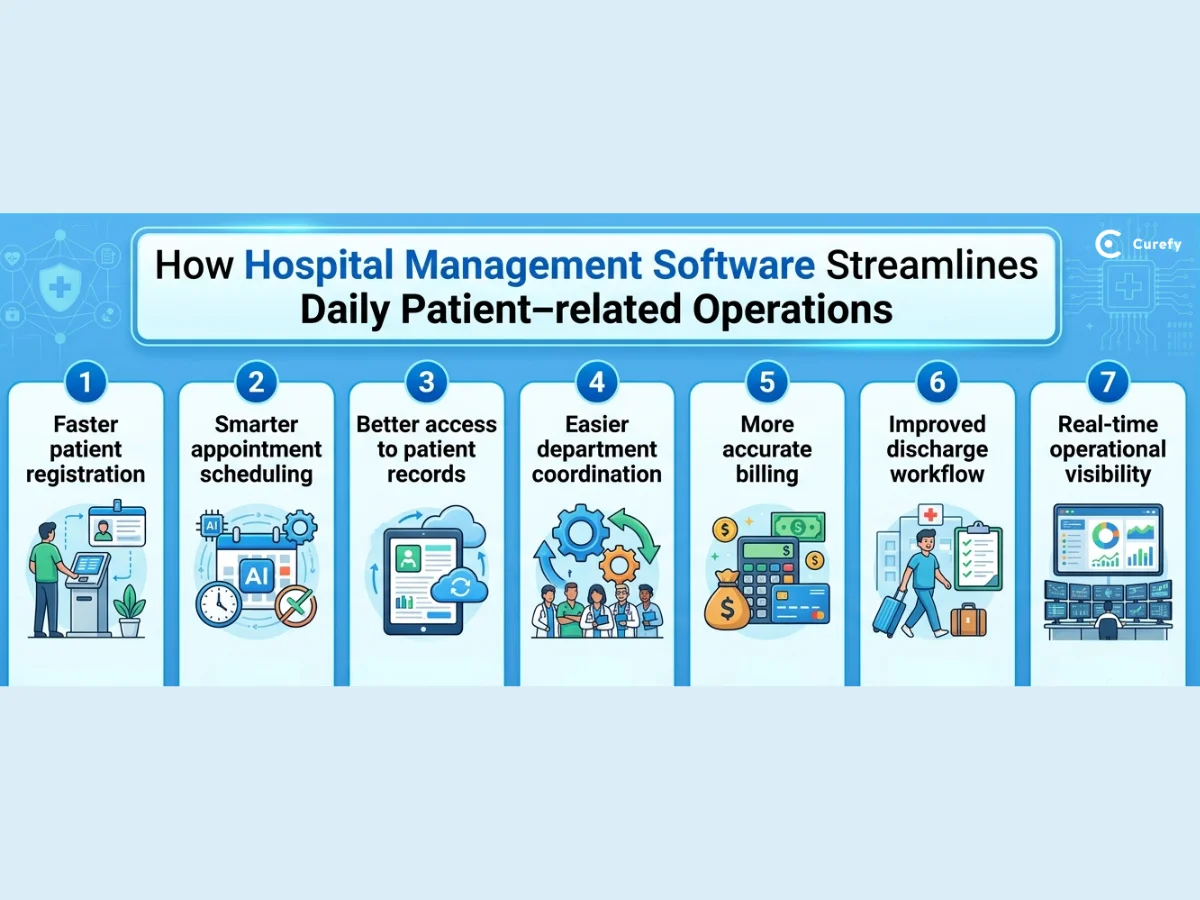
Using a hsopital management software brings a lot more to your practice than just automating patient data collection and retrieval. Here are the top benefits of using a dedicated hospital management software that takes care of everything for your team:
1. Faster patient registration
Instead of repeating the same information at every visit, staff can pull up existing patient details instantly. This reduces queue times, avoids duplicate entries, and helps front-desk teams move patients through the system faster.
2. Smarter appointment scheduling
A hospital management software comes with smart appointment scheduling that manages doctor availability, patient reminders, follow-ups, and cancellations. This reduces no-shows and makes clinic schedules more predictable and clear for your patients to navigate.
3. Better access to patient records
When records are stored digitally, doctors can review history, medications, allergies, test results, and prior visits without searching through paper files. This improves clinical decision-making and saves time during consultations, reducing errors and promoting quick, informed decision-making.
4. Easier department coordination
A patient may move from reception to consultation, then to diagnostics, pharmacy, and billing. A centralized system allows each department to see the same updated information, reducing confusion and repeated questions. This is essential for departments to stay on the same page and prevent duplicate records in a patient's journey - keeping your patient's experience at the top level.
5. More accurate billing
Billing errors often happen when services are not recorded properly or when departments work in isolation. Hospital management software links treatment data to billing, which improves accuracy and speeds up claims and payments. This helps patients and the billing department be clear on what is being charged.
6. Improved discharge workflow
Discharge summaries, prescriptions, instructions, and follow-up appointments can be generated faster when the patient’s data is already in the system. This helps patients leave on time and keeps beds available for the next in line - supporting a fully-booked schedule for your hospital without any delay or overlaps.
7. Real-time operational visibility
Admins can monitor patient flow, bed occupancy, appointment trends, revenue, and department performance through dashboards and reports. This helps hospitals make decisions based on data instead of guesswork.
How Your Hospital Operations Benefit from It
Here are the key benefits of using hospital management system for patient care where your frontdesk sees smoother daily operations:
|
Area |
Manual Process |
With Hospital Patient Management Software |
|---|---|---|
|
Registration |
Slow, paper-heavy, repetitive |
Fast digital entry and reuse of data |
|
Scheduling |
Phone-based and fragmented |
Centralized calendar and reminders |
|
Records |
Paper files or scattered systems |
Secure digital access in one place |
|
Billing |
Prone to errors and delays |
Automated linking of services and charges |
|
Reporting |
Time-consuming to compile |
Instant dashboards and reports |
Why Hospitals Prefer Digital Records
The move to hospital records online is not just about convenience. It helps hospitals reduce lost files, improve information sharing, and support better patient care.
Digital records are especially useful in multi-specialty hospitals where several teams may need access to the same patient’s information. A secure and well-structured system makes that possible without adding administrative burden.
What to Look for in the Best Hospital Management Software
Curefy's patient management software bring every little detail in one place within a fully secure environemt that protects and preserves your practice's legacy. When choosing the best hospital management software, hospitals should look for:
-
Easy-to-use interface for staff.
-
Secure access control and patient data protection.
-
Appointment, billing, pharmacy, and lab integration.
-
Reporting and analytics tools.
-
Support for multi-location or multi-department operations.
-
Cloud access for authorized users.
-
Customization for the hospital’s workflow.
The best solution is not just feature-rich; it should also match the hospital’s size, specialty, and daily workload.
Impact on staff and patient experience
For staff, hospital software reduces repetitive admin work and helps them focus on patients instead of paperwork. For patients, it means shorter waiting times, smoother visits, and fewer errors.
That combination makes hospital patient management software a practical investment for both operational efficiency and service quality.
Final thoughts
Hospital management software helps healthcare providers simplify scheduling, improve records management, speed up billing, and create better coordination across departments. As hospitals move toward hospital records online, digital systems are becoming essential for efficient daily operations.
Get in touch today to streamline your patient management!